

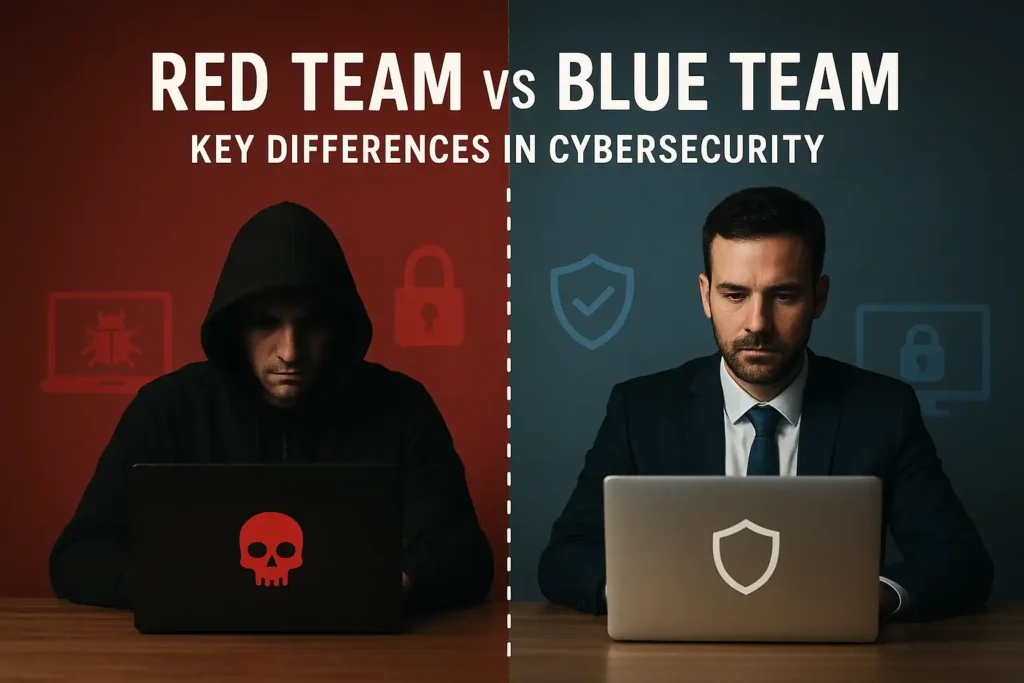
In the fast-changing world of cybersecurity, attackers are always finding new ways to break into systems, while defenders work tirelessly to stop them. This constant battle has given rise to a unique practice: Red Team vs Blue Team exercises. These simulated “attack vs defend” scenarios help organizations test their defences, strengthen their response strategies, and uncover hidden vulnerabilities before real hackers do.
But what exactly are Red Teams and Blue Teams? And how do they differ? Let’s dive into the key differences, roles, and benefits of each.
What is a Red Team in Cybersecurity?
A Red Team acts as the attacker. Their job is to think and operate like cybercriminals to identify weak points in an organization’s security.
Roles & Objectives of a Red Team
- Simulate real-world cyberattacks.
- Attempt phishing campaigns, social engineering, and malware injection.
- Exploit vulnerabilities in networks, applications, and employee awareness.
- Report findings to help strengthen defences.
Common Red Team Tools
- Metasploit (penetration testing)
- Nmap (network scanning)
- Cobalt Strike (adversary emulation)
- Social engineering kits
In short, Red Teams don’t just look for flaws, they act like hackers to show how much damage could be done.
What is a Blue Team in Cybersecurity?
A Blue Team acts as the defender. Their responsibility is to protect systems, detect suspicious activity, and respond quickly to attacks.
Roles & Objectives of a Blue Team
- Monitor networks for anomalies and threats.
- Strengthen firewalls, intrusion detection systems, and endpoint security.
- Conduct threat hunting and forensic analysis.
- Develop incident response plans.
Common Blue Team Tools
- SIEM platforms (Splunk, IBM QRadar)
- Intrusion Detection Systems (IDS)
- Endpoint Detection & Response (EDR) solutions
- Log analysis tools
Blue Teams don’t just react to attacks they build proactive defences to stop hackers before they succeed.
Red Team vs Blue Team: Key Differences
| Feature | Red Team (Attackers) | Blue Team (Defenders) |
| Primary Role | Offensive – simulate real-world attacks | Defensive – protect, detect & respond |
| Goal | Find & exploit vulnerabilities | Prevent, detect & mitigate attacks |
| Mindset | Think like hackers | Think like protectors |
| Techniques | Phishing, malware, penetration testing | Threat hunting, monitoring, forensics |
| Key Outcome | Reveal security gaps | Strengthen defence & incident response |
Purple Team: The Best of Both Worlds
While Red and Blue Teams often operate separately, a Purple Team bridges the gap. They encourage collaboration, sharing insights between attackers and defenders to build stronger, smarter cybersecurity strategies.
Think of Purple Teams as coaches, ensuring both sides learn from each other.
Why Red vs Blue Team Exercises Matter
- Realistic Testing: Simulations mimic actual hacker tactics.
- Stronger Defence: Helps patch weak spots before attackers exploit them.
- Faster Response: Improves detection and reaction times.
- Employee Awareness: Trains staff against phishing & social engineering.
Real-World Example
Imagine a Red Team launches a phishing attack against a company. If employees click the malicious link, the Red Team gains access. The Blue Team then detects unusual login attempts, cuts off access, and investigates. Later, both teams meet to discuss lessons learned, helping the company improve email filters and staff training.
How to Decide Which Team Your Organization Needs
- Small Businesses: Start with a Blue Team or outsource monitoring.
- Medium Enterprises: Combine Blue Team defence with occasional Red Team assessments.
- Large Organizations: Use Red, Blue, and Purple Teams for full coverage.
Conclusion
The Red Team vs Blue Team model is more than just a cybersecurity exercise, it’s a powerful way to stay ahead of attackers. Red Teams sharpen an organization’s awareness of threats, while Blue Teams ensure resilience against them. Together, and with the help of Purple Teams, they create a cycle of continuous improvement.
In today’s digital battlefield, the winner is the one who’s always prepared.
FAQs
Q1. What is the main difference between Red Team and Blue Team? Red Teams simulate attackers, while Blue Teams defend against attacks.
Q2. What tools do Red Teams use? They use penetration testing and exploitation tools like Metasploit, Nmap, and Cobalt Strike.
Q3. How does a Purple Team help? Purple Teams connect Red and Blue Teams, improving collaboration and security outcomes.
Q4. Why are Red vs Blue Team exercises important? They help organizations find vulnerabilities, strengthen defences, and improve incident response.
Q5. Can small businesses benefit from these exercises? Yes, even small businesses gain valuable insights by simulating attacks and testing defences.